


Posted by Tammy on 11th Jun 2026
Blissful about Batting
Batting is one of the last decisions you will need to make when you are ready to finish up your quilt. How do you decide? There are many different brands and blends. Where do you start?
First let’s go over some terminology often heard when talking about batting:
Bearding or Migration: This is when the batting fibers separate and start working their way through the weave of the fabric, escaping the quilt on either the front or the back and sometimes both.
Drape: How your quilt feels and hangs after being quilted. Good batting allows your quilt to drape without being too stiff.
Loft: This refers to the puffiness of the batting. Cotton is typically low loft but is available in several different thicknesses so you can find higher loft cotton batting. Polyester is generally high loft.
- Low-loft batting is the easiest to machine and handle and is soft and drape-able. Medium-loft batting adds texture, gives your piece a fuller look, and is warmer, but the higher the loft the harder to machine and hand quilt.
- High-loft batting is good for highlighting detailed quilting and is like the look of down, and is often used in hand tied quilts
Batting is often constructed of different types of fibers held together using various methods. This process keeps your batting from clumping or breaking apart inside your quilt.
Here are the most common methods for holding the fibers together:
Bonded: The fibers are bonded together by either thermal or resin method. Thermal bonding has a low melt fiber blended with standard polyester to hold it together. This can allow bearding but doesn’t break down with washing and dry cleaning as fast as resin bonded batting. Resin bonded batting is made from a variety of fibers including polyester, cotton, and wool. Resin is applied to both sides then dried and cured. This makes it resist bearding better than any other batting.
Needle-punched: In this method the fibers are mechanically felted together by punching them with thousands of tiny needles. This causes the batting to be stronger and denser while being lower loft. Because of the denseness, this batting it isn’t generally good for hand quilting. These battings will tend to migrate but will not bunch and shift. Needle-punched batting can be thermal, or resin bonded.
Scrim: A thin stabilizer that is needle-punched into the batting to add strength, loft, and reduce stretching and distorting.
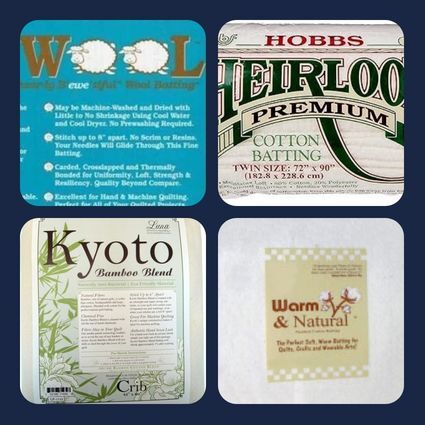
The most often used fibers for battings are cotton, polyester, wool, and blends, although bamboo is becoming more commonplace.
Here are some differences, with my opinions of each:
Cotton: Cotton is soft, breathable, and a natural fiber that can usually be found in several different lofts. It is machine washable and dry-able, has good drape and ages well. It will soften, wrinkle and shrink with washing and give your quilt a “well loved” look. It’s the go to choice for quilters looking to make quilts that will stand the test of time. The low loft makes it great for anything you want to be flat such as place mats, table runners, bags, etc. You can get cotton batting with scrim which gives it more loft, like polyester.
Polyester: Usually has good drape and has the most loft, so it can make the quilting stand out. It retains its shape no matter how many times it’s washed and is lighter than cotton. It doesn’t breathe like cotton and can beard. This is great for baby quilts and lap quilts that will be repeatedly washed and is usually the most economically priced option. The higher loft also makes it a good choice for wall hangings and dimensional projects.
Wool: Great drape, regulates body temperature and is very strong. Good for both machine and hand quilting. No scrim or resins. You have to be very careful when laundering quilts made with wool batting because if you don’t follow instructions and wash it in warm water or dry it then you will end up with felted clumps in your quilt instead of nice flat batting. Wool is great for bed quilts and quilted jackets or anything you want to be extra warm.
Blends: These are usually cotton and polyester blended in an 80/20 or 70/30 configuration. Long arm quilters tend to love the cotton/poly blend as they combine the easy handling of cotton but add some loftiness of polyester to make the quilting stand out better.
Bamboo: The most common bamboo batting I have seen is a blend of 50/50 organic cotton and bamboo. It’s very soft with great drape, and it’s good for hand and machine quilting. A side benefit of this batting is that bamboo is naturally antibacterial. It can tend to beard, so don’t use it with dark fabrics. For darker fabrics, I would recommend using black batting to solve any bearding issues.
There are other types of batting depending on the need of your project, here are just a few:
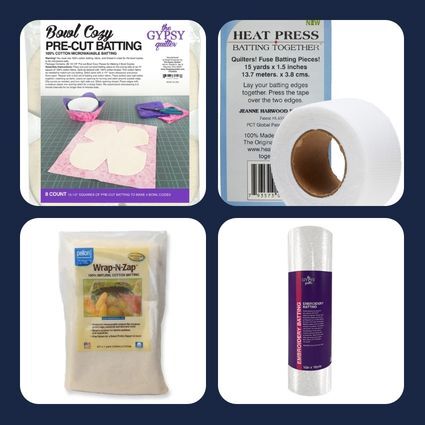
Fusible Batting: You can buy batting that already has fusible applied so that just by using the iron it temporarily attaches the top, batting, and backing together, rather than having to baste or pin the layers. This is especially great for smaller projects.
Wrap-N-Zap: This is a 100% natural, additive-free cotton batting designed specifically for microwave-safe craft projects like bowl cozies, potato bags, and casserole warmers. It traps moisture to steam food perfectly, but contains no fire retardants, making safety and material choices critical. It is 100% pure, natural cotton fibers without any synthetic additives or scrim.
Insul-Bright: This is an insulated, needle-punched polyester batting featuring a reflective, metalized film. It is designed to reflect both radiant hot and cold energy back to its source, making it a staple material for DIY oven mitts, potholders, and thermal lunch bags.
Heat Press Batting Tape: This is a great way to use up all the left-over pieces of batting. It is a lightweight, fusible cloth tape used by quilters to join smaller batting scraps into one continuous piece. It stretches, doesn’t add bulk, and eliminates the need for pinning or hand-sewing
Now that you know you have options and ultimately another decision, which do you prefer? Some quilters have a go to brand and type that they swear by. But, as with this hobby, you have the final say. Hopefully I have helped you a little with the next to the final choice, (yes, there is one more but that’s a story for another day!)